The State of Cloud in Mid-2026
2026-07-13 · 24 min read
The three logos stopped being the whole map
Ask most people to name a cloud provider and you get three answers, in some order, and then silence. That silence used to be fine. It isn't anymore. Amazon, Microsoft, and Google still carry 63% of the $128.6 billion spent on cloud infrastructure last quarter, and that number itself is worth sitting with: nine straight quarters of accelerating growth, not slowing, in a market analysts have called mature since roughly 2019 (Synergy Research Group, 2026). The acceleration has one cause. IDC puts global AI infrastructure spend at $318 billion in 2025, forecasting $487 billion this year and more than a trillion by 2029 (IDC, 2026). Every dollar of that has to land on physical silicon somewhere, and the three companies that own the most silicon are winning by default, whether or not their product is the best fit for what you're building.
But the map underneath those three names has redrawn itself twice in the last twelve months in ways that change real decisions. First: the exclusivity era ended. For years, picking a cloud meant picking a model family bundled to it, OpenAI meant Azure, full stop. That coupling broke in 2026. Second: a hyperscaler put physical infrastructure inside Vietnam for the first time, arriving in the same year a new data-protection law made "where does this data live" a board-level question for banks and hospitals. Neither of those facts fits on Synergy's usual three-bar chart. This is an attempt to put the whole picture in one place, checked against provider pricing pages and Q1 2026 earnings releases as of 13 July 2026.
Part One: Who's winning, and why the backlog matters more than the pie chart
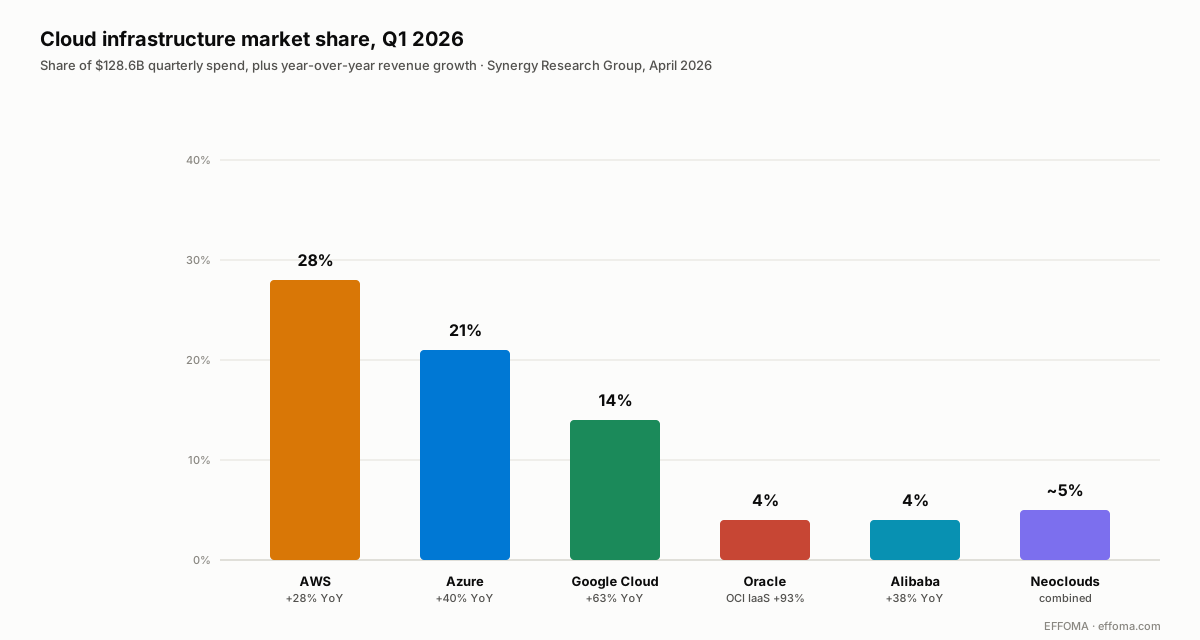
The share numbers understate what's happening, because share is a lagging measure of a market where the real signal is what's already been sold and not yet delivered. Microsoft's commercial remaining performance obligations, contracts already signed but not yet billed, hit $627 billion, up 99% year over year. Oracle's backlog reached $638 billion, up 363%. Google Cloud's exceeds $460 billion. Read those three numbers together and the story isn't "who has the biggest slice today," it's that enterprises are pre-committing to multi-year AI capacity at a scale nobody has done before, and the vendors are racing to build the physical plant to fill those contracts. Amazon guided roughly $200 billion in 2026 capital spending. Alphabet raised its own guidance to $180–190 billion. Microsoft spent $80.1 billion in nine months of its current fiscal year (Q1 CY2026 earnings releases; company 10-Q and 8-K filings, 2026).
| Provider | Share | YoY revenue | The backlog signal |
|---|---|---|---|
| AWS | 28% (down from 29%) | $37.6B, +28% — fastest in 15 quarters | Anthropic alone committed $100B+ over 10 years to AWS compute |
| Microsoft Azure | 21% (down from 22%) | Azure +40%; Microsoft Cloud $54.5B | Commercial RPO $627B, +99% |
| Google Cloud | 14% (up from 12%) | $20.0B, +63% — first $20B quarter | Backlog exceeds $460B |
| Oracle | 4% (up from 3%) | OCI IaaS $5.8B, +93% | RPO $638B, +363%, against –$23.7B free cash flow |
| Alibaba Cloud | 4%, flat | ~$6.0B, +38% | ~$53B AI infrastructure program |
| Neoclouds (CoreWeave et al.) | ~5% combined | CoreWeave alone $2.08B, +~112% | CoreWeave's own backlog: $99.4B, including a $21B Meta deal |
Read the direction of travel, not the snapshot: AWS is still first by a wide margin and its growth rate just hit a 15-quarter high, which quietly answers the "is AWS getting disrupted" question circulating since 2024. Google is the one closing the gap fastest, and its own TPU silicon is a real part of why. Oracle's negative free cash flow against a $638 billion backlog is the sentence that should worry anyone extending Oracle credit, and the reason every cloud vendor's capex guidance keeps climbing: they are all borrowing against demand they have not yet delivered.
Setup and the first hour with each console
Everyone who has opened all three consoles in the same week comes away with the same ranking, so it's worth just saying it plainly rather than pretending it's close. Google Cloud's console is the cleanest of the three, and its networking is the reason: VPCs are global by default, one network spanning every region with no peering to configure, and live migration moves a VM off a failing host with sub-second disruption instead of a reboot window (the one exception is GPU and TPU instances, which still take the hit). AWS has the broadest catalog, over 200 services, and the steepest climb; IAM is powerful and famously fiddly, and almost nobody manages it by hand once the account count passes single digits, they live in Terraform or the CDK instead. Azure's real advantage isn't the console, it's what's already true before you sign up: if the organization runs Microsoft 365 and Entra ID, Azure onboarding reuses the same identity and the same billing relationship, and that continuity is worth more than any UI polish.
Free-tier shape changed enough this year to matter for a startup's first month. AWS moved from its old 12-month free tier to a credits model for accounts created after 15 July 2025: up to $200, split between a $100 signup credit and $20 per onboarding activity, expiring after six months rather than twelve. Azure still gives $200 for 30 days plus twelve months of specific free services. Google gives $300 for 90 days plus an always-on e2-micro instance. Oracle's Always Free tier is the one that lives up to its name: two Ampere ARM OCPUs and 12 GB of RAM, running forever, no expiry, the most generous permanent free compute anyone in the industry offers (provider pricing pages, verified 13 July 2026).
The prices, checked against the calculators
Entry-level general-purpose VMs, on-demand, Linux, US regions:
| Instance | Specs | USD/hour |
|---|---|---|
| AWS t3.medium | 2 vCPU / 4 GiB | $0.0416 |
| AWS t4g.medium (Graviton ARM) | 2 vCPU / 4 GiB | $0.0336 |
| Azure B2s | 2 vCPU / 4 GiB | $0.0416 |
| GCP e2-medium | 2 shared vCPU / 4 GB | $0.0335 |
AWS and Azure price their entry x86 burstable instance identically to the tenth of a cent, which is either a coincidence or evidence of how commoditized entry compute has become. The gap only opens on ARM: AWS's Graviton instance runs about 19% cheaper than its own x86 equivalent, and GCP's shared-core E2 family undercuts both.
Object storage, standard tier, first terabyte:
| Service | USD/GB/month |
|---|---|
| GCS Standard (us-central1) | $0.020 |
| Azure Blob Hot LRS (East US) | $0.0208 |
| S3 Standard (us-east-1) | $0.023 |
The real money is in egress, the fee for moving data back out to the internet, and the spread here is where architecture decisions get made:
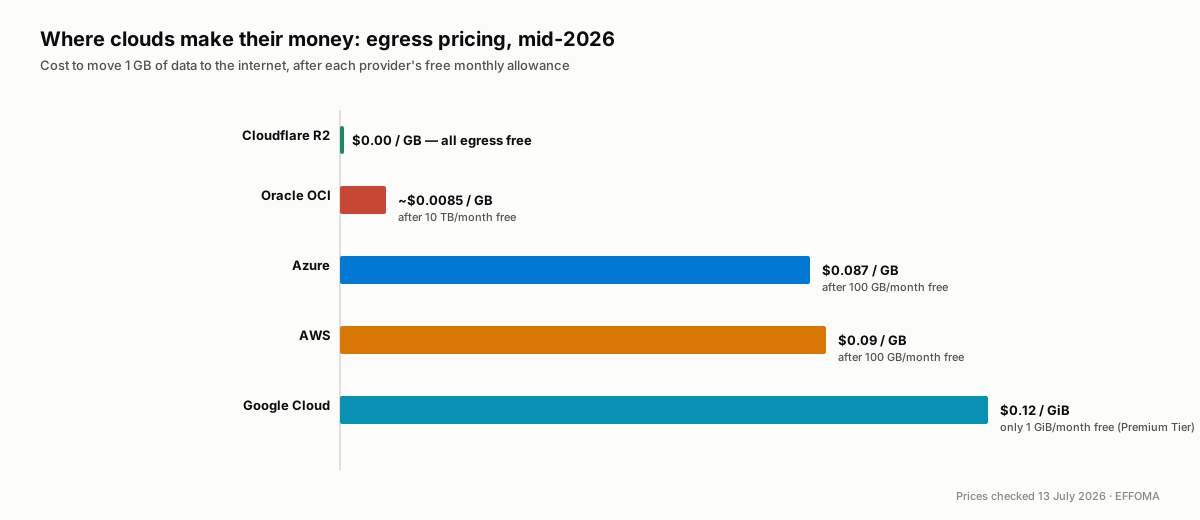
Two traps hide in that chart. Google has no 100 GB free egress tier the way AWS and Azure do, its cheaper Standard networking tier only kicks in after 200 GiB and comes with reduced performance, and Google bills in gibibytes while AWS and Azure bill in gigabytes, a quiet 7% difference that never shows up in a quick mental comparison. For a content-heavy or data-serving product, Oracle's 10 TB free allowance and Cloudflare R2's zero-egress model aren't a rounding difference, they change which architecture is even worth building. One rumor worth killing here: a claim circulated in early 2026 that Oracle made all egress free. Oracle's own pricing page still says 10 TB a month. That's the number to use.
Part Two: The end of model exclusivity, and what differentiates the AI stack now
This is the single biggest structural shift of the year, and it's easy to miss because it happened through a legal filing rather than a product launch. Following the April 2026 restructuring of the Microsoft–OpenAI relationship, which made OpenAI's IP license non-exclusive through 2032, GPT-5.5, GPT-5.4, and Codex went generally available on AWS Bedrock on 1 June 2026. Anthropic went further in the other direction: Claude Fable 5, the flagship released 9 June 2026, launched simultaneously on Bedrock, Google Vertex AI, and Microsoft Foundry. Neither company is locked to one distributor anymore, and neither is any customer.
That single fact resets the whole basis on which people used to pick a cloud for AI work. Model choice used to be a cloud decision. It no longer is; the same frontier models run everywhere, and the differentiators moved one layer down, into agentic tooling, custom-silicon inference economics, and data gravity.
| AWS | Azure | Google Cloud | |
|---|---|---|---|
| Model marketplace | Bedrock: Claude, OpenAI, Nova 2, Llama, Mistral | Foundry: 1,900+ models, deepest OpenAI catalog | Vertex AI: Gemini, Claude, Veo 3.1, Lyria 3 |
| Agentic runtime | AgentCore (GA Oct 2025) — memory, tools, guardrails, multi-agent orchestration | Foundry Agent Service, selectable inside M365 Copilot | Vertex Agent Builder |
| Custom silicon | Trainium3 UltraServers (Dec 2025) — 3nm, claimed 4.4× Trainium2 | Maia 200 (Jan 2026) — internal production only, not yet rentable | TPU Ironwood v7 (GA Nov 2025) — 9,216-chip pods |
| The tell | Anthropic committed $100B+ over 10 years; Claude runs on 1M+ Trainium2 chips | Seven in-house MAI models unveiled at Build 2026, including reasoning model MAI-Thinking-1 | Gemini 3.5 Flash shipped 19 May 2026; 3.5 Pro still "coming soon" as of this writing |
If model choice no longer decides the cloud, three things still do: how mature the agent runtime is for production use, how the inference economics work out on each vendor's own silicon, and, more than either, where the data already sits. A bank that already keeps its core ledgers in Azure SQL is not moving that estate to save a fraction of a cent on inference.
Performance, in the claims that survive contact with a benchmark
AWS's Graviton5, announced November 2025 with M9g instances now generally available, claims up to 25% better compute performance than Graviton4, and AWS's broader claim is up to 20% lower cost and 60% less energy than comparable x86, with over half of new AWS CPU capacity now running on Graviton. The 40% figure that still circulates online is not this year's claim, it's the original 2019 Graviton2 launch number, still being repeated as if it described the current chip. GCP's Axion ARM chip carries Google's own claim of up to 65% better price-performance against x86; the last independent test anyone can point to, Phoronix in November 2024, measured Axion roughly 10% ahead of Graviton4 at 48 vCPU, a real but far smaller margin than the marketing number. No independent benchmark exists yet for Graviton5 or Azure's Cobalt 200, both too new. Azure's real differentiator was never a chip benchmark; it's Entra ID, Microsoft 365, and Arc hybrid management, the kind of advantage that doesn't show up on a spec sheet and doesn't need to.
Part Three: news that changed the calculus, January to July 2026
AWS. The Hanoi Local Zone went GA on 19 June 2026, the first AWS infrastructure physically inside Vietnam, with day-one customers including VIB, VPBank, Techcombank, MoMo, and Vinamilk (this is covered in full below). Separately, the AWS European Sovereign Cloud went GA on 15 January 2026, its first region in Brandenburg, Germany, run through a legally distinct European parent company with German subsidiaries and EU-citizen leadership, backed by more than €7.8 billion in German investment. That's the most concrete answer any hyperscaler has given to European data-sovereignty demands, a legal entity, not just a region flag. AWS also announced $33 billion in Southeast Asia investment through 2039, and expanded its OpenAI relationship with up to $50 billion invested into OpenAI's $110 billion round.
Microsoft Azure. The OpenAI restructuring is the headline of the whole year for Azure, covered above. Microsoft Cloud crossed $50 billion in quarterly revenue for the first time. On sovereignty, the EU Data Boundary completed in February 2025, followed by a formal "Microsoft Sovereign Cloud" launch, and the SAP-owned Delos Cloud, built on Microsoft technology for the German public sector, formed a Franco-German alliance with France's Bleu in late 2025.
Google Cloud. A Bangkok region went live 21 January 2026 on a $1 billion investment. The Wiz acquisition closed 11 March 2026 at $32 billion, the largest acquisition in Alphabet's history, a serious statement that Google intends to compete on cloud security, not just compute.
Oracle and Alibaba. Oracle posted record OCI growth, IaaS up 93%, against negative $23.7 billion free cash flow for the year, a reminder that the AI buildout is expensive for the vendors funding it too, not only for the customers paying the bills. Alibaba opened new data centers in Japan, Malaysia, France, and Mexico in the first half of 2026 under a roughly $53 billion AI infrastructure program; a rumored $1 billion Vietnam data center remains a plan rather than a fact, and Alibaba's actual Vietnam presence today is colocated through Viettel and VNPT.
Part Four: the rest of the map a solutions architect needs
Three logos was never the whole picture, and treating it as one is how architects miss the tier that would have solved their real problem for a tenth of the price.
Second-tier hyperscalers and national clouds
| Provider | Where it stands mid-2026 | What it's for |
|---|---|---|
| IBM Cloud | Cloud revenue "essentially flat" per Synergy; IBM overall grew, Q1 2026 revenue $15.9B (+9%), IBM Z infrastructure up 51% | Mainframe and Power estates, Red Hat/OpenShift hybrid, financial-services-grade compliance |
| Tencent Cloud | ~10% of China's cloud market; international arm reportedly growing ~40% YoY | Gaming and media workloads across APAC, 23 regions including Singapore, Bangkok, Jakarta |
| Huawei Cloud | China's #2 cloud at ~17–18% share | Ascend AI silicon, a NVIDIA-independent compute path as Chinese firms diversify off US chips |
| OVHcloud | FY25 revenue €1,084.6M, +9.3% | European-owned, price-competitive bare metal for EU sovereignty on a budget |
| StackIT / Delos / Bleu | Emerging German and French sovereign stacks | Legal sovereignty, distinct from data residency, for EU public sector and sanction-contingency planning |
The one-line version of the European sovereignty story: European providers still hold only about 15% of their own continent's cloud market (Synergy Research, 2026), which is exactly why AWS built a legally separate European entity instead of just another region, and why every European public-sector RFP now carries a dedicated sovereignty section.
Budget IaaS, for the workloads that don't need 200 services
Staging environments, side products, self-hosted tooling, anything you'd containerize anyway, all run dramatically cheaper outside the hyperscalers. Entry VM roughly 2 vCPU / 4 GB, prices checked 13 July 2026:
| Provider | Entry VM | Included egress | Watch out for |
|---|---|---|---|
| Hetzner | CX23, €5.49/mo (ARM CAX11 €5.99) | 20 TB in the EU, less in US/SG | Raised entry prices ~30–38% across 2026; still cheapest, thin APAC footprint |
| Scaleway | DEV1-M (3c/4GB), €14.74/mo | Unmetered, speed-capped instead of billed | EU-only regions, no APAC |
| Vultr | ~$20/mo | ~3 TB | Widest budget footprint, 33 regions including APAC; now also runs an AMD GPU cloud |
| DigitalOcean | Basic Droplet, $24/mo | 4 TiB pooled | The polished-DX pick; Q1 2026 revenue $258M (+22%), AI ARR $170M (+221%) |
| Linode / Akamai Cloud | Linode 4GB, $24/mo | 4 TB | Cheapest overage verified, $0.005/GB; rebranded as Akamai Cloud, pairs with Akamai's edge |
The trade at this tier is a clean one to state and a hard one to argue against: 3 to 10 times lower compute and egress cost, in exchange for managed-service depth you give up. That's a rational trade for a stateless web app or a dev environment, and an irrational one the moment you need IAM depth, compliance attestations, or a GenAI platform layer.
GPU and AI-specialist clouds
The neocloud tier now holds roughly 5% of the entire cloud market, and the on-demand per-GPU-hour pricing tells you exactly what it's for:
| Provider | H100/hr | H200/hr | B200/hr | Best for |
|---|---|---|---|---|
| RunPod | $2.89–3.19 | $4.39 | $5.89 | Cost-sensitive, spiky workloads |
| Nebius | $3.85 | $4.50 | $7.15 | Publicly listed scale, Q1 2026 revenue +684% YoY |
| Crusoe | $3.90 | $4.29 | on request | Committed capacity plus an energy story, building the Abilene "Stargate" campus |
| Modal | ~$3.95 | ~$4.54 | ~$6.25 | Serverless, per-second billing, scale-to-zero |
| Lambda | $3.99–4.29 | — | $6.69–6.99 | Training clusters; IPO targeted H2 2026 |
| Together AI | $3.99 (reserved from $3.09) | $5.99 | $8.19 | Open-model inference and fine-tuning |
| Fireworks | $7.00 | $7.00 | $10.00 | Low-latency production inference |
Hyperscaler GPU pricing buys the platform wrapped around the chip: IAM, VPC, managed data services. Neocloud pricing buys more FLOPS per dollar and earlier access to each new NVIDIA generation. Production inference at a regulated enterprise leans hyperscaler or hybrid; a research training run or a startup burning investor capital leans neocloud.
The PaaS layer, where the right answer is often not touching raw cloud at all
| Platform | Positioning | The 2026 story |
|---|---|---|
| Vercel | "AI Cloud" — Next.js, v0, AI SDK, Fluid compute | $300M Series F at a $9.3B valuation |
| Netlify | Agent-first pivot, AI Gateway, Agent Runners | Pro tier is $20/mo flat, unlimited members, a real anti-per-seat move |
| Fly.io | MicroVMs plus Sprites, hardware-isolated sandboxes for AI-generated code | The isolation-for-untrusted-agent-code niche none of the hyperscalers filled |
| Railway | Full-stack PaaS on its own hardware, off GCP | In May 2026 Google Cloud erroneously suspended Railway's account for roughly eight hours — a live example of control-plane risk on someone else's cloud |
| Render | The Heroku successor for SMB teams | $80M Series C plus extension at a reported $1.5B valuation |
For a frontend-heavy team without platform engineers, Vercel or Netlify genuinely reduce time-to-ship. For API backends, Railway, Render, and Fly close the gap between "Heroku was easy" and "now we need a VPC," and the Railway incident is the architecture lesson of the year for that whole tier: know where your provider's control plane lives, not just where your data sits.
The data platform layer, which now decides the infrastructure layer underneath it
Two names come up in nearly every enterprise cloud conversation regardless of which hyperscaler is on the table. Snowflake's FY26 product revenue hit $4.47 billion, up 29%, and accelerated into Q1 FY27 at $1.33 billion, up 34%, with net revenue retention at 125%. Its strategic bet is "Agentic Enterprise," Cortex AI now live in over 13,600 accounts, plus a move into Postgres and OLTP territory via the Crunchy Data acquisition. Databricks is the larger private-market story: a Series K crossing $100 billion in valuation, a Series L reportedly at $134 billion, and mid-2026 reports of a new round in talks at $165–175 billion, against CEO Ali Ghodsi's cited $6.9 billion annualized revenue growing more than 80%. Both run on all three hyperscalers, competing directly with each vendor's native warehouse while driving that same vendor's compute consumption, the defining frenemy relationship of enterprise data infrastructure.
The practical read for an architect: for many enterprises, the data-platform decision, Snowflake versus Databricks versus native BigQuery, Fabric, or Redshift, now comes before the cloud decision, and it constrains or frees whatever gets built on top.
Part Five: Vietnam, and why the map finally has a local pin
Vietnam's cloud story used to be simple because there was nothing to say: no hyperscaler had physical compute inside the country, so every "data residency" conversation was really a compliance workaround, colocation through a domestic telecom, or an honest admission that the data lived in Singapore. That changed on 19 June 2026, when AWS's Hanoi Local Zone went generally available, the first hyperscaler infrastructure physically inside Vietnam, offering EC2, S3 One Zone-IA with local snapshots, and Direct Connect, at single-digit-millisecond latency for Hanoi-based workloads. Day-one customers included VIB, VPBank, Techcombank, MoMo, and Vinamilk. It's worth being precise about what this is and isn't: a Local Zone is not a full AWS region, and no full Vietnam region has been announced.
The timing is not a coincidence. Vietnam's Personal Data Protection Law, Law 91/2025/QH15, took effect 1 January 2026, layered on top of the existing Decree 53/2022 localization requirements. For a bank, an insurer, a hospital, or a government workload, "where does the data physically live" stopped being a compliance footnote and became a first-order architecture question, and as of June, AWS is the only hyperscaler that can answer it with infrastructure inside the country.
| Provider | Singapore | Indonesia | Malaysia | Thailand | Vietnam |
|---|---|---|---|---|---|
| AWS | live | live (Jakarta) | live (2024) | live (Jan 2025) | Hanoi Local Zone (Jun 2026) |
| Azure | live | live (May 2025) | live (May 2025) | announced | none |
| GCP | live | live (Jakarta) | announced | live (Jan 2026) | none |
| Oracle | live ×2 | none | announced | none | none |
| Alibaba | live | live | live | live | data center planned |
The domestic alternatives are catching up rather than standing still. Viettel's 140 MW hyperscale data center in Ho Chi Minh City targeted Phase 1 for early 2026, VNPT and FPT both run domestic infrastructure, and NVIDIA has separately entered sovereign-AI partnerships with both FPT and Viettel. Vietnamese enterprises now have real residency options for the first time, rather than a compliance workaround dressed up as an architecture decision.
The market-level numbers worth keeping in your back pocket
| Stat | Figure | Source |
|---|---|---|
| Cloud infra services, Q1 2026 | $128.6B quarterly, +35% YoY; over $500B annualized | Synergy Research, April 2026 |
| Public cloud end-user spend, 2025 | $723.4B, +21.5%, ~21.3% growth projected for 2026 | Gartner |
| AI infrastructure spend | $318B in 2025, $487B forecast for 2026, over $1T by 2029 | IDC, April 2026 |
| Hybrid cloud adoption | 73% of organizations, up 3 points YoY | Flexera State of the Cloud 2026 |
| Top cloud challenge, 4th year running | Cost management at 85%, ahead of security at 82% | Flexera 2026 |
| Orgs managing AI spend under FinOps | 98%, up from 63% in 2025 and 31% in 2024 | State of FinOps 2026, FinOps Foundation |
That fourth row is the quiet headline of the whole year: four consecutive years where the biggest problem in cloud computing is not getting breached, it's the bill.
A decision framework, not a summary
| If you are… | The pick | Why |
|---|---|---|
| Running GenAI in production | AWS, narrowly, or GCP if TPU/Gemini-aligned | Same frontier models everywhere now; Bedrock's breadth and AgentCore maturity are the differentiator, not the model |
| Already standardized on Microsoft 365 | Azure | The identity and licensing continuity is worth more than any benchmark |
| Building analytics and BI, no platform chosen yet | GCP, or let the data platform decide | BigQuery is still the benchmark, but Snowflake or Databricks choices come first if already made |
| Training models or burning GPU hours | Neoclouds — RunPod for cost, Lambda or Nebius for scale, Modal for serverless | More FLOPS per dollar, earlier access to each NVIDIA generation |
| Running regulated AI inference | A hyperscaler | Compliance, IAM, and private networking matter more than the GPU's sticker price |
| A cost-sensitive startup | Mixed: AWS Activate credits, Oracle Always Free for dev infrastructure, Hetzner or DigitalOcean for predictable bills | The free tiers and budget IaaS solve different problems; use the one that fits the stage you're at |
| A frontend-heavy team without platform engineers | Vercel or Netlify | Time-to-ship beats infrastructure control at this layer |
| Shipping an API backend with no dedicated infra team | Railway, Render, or Fly.io | The Heroku-shaped gap, filled — just confirm where the control plane actually lives |
| Bound by EU sovereignty requirements | AWS European Sovereign Cloud, or a national stack like Delos, Bleu, or OVHcloud | Legal-entity sovereignty arrived in January 2026; picking the Frankfurt region is no longer sufficient |
| Building for regulated industries in Vietnam | AWS's Hanoi Local Zone for the residency-sensitive tier, paired with a full region for everything else | Pair local presence with domestic hybrid — Viettel, VNPT, or FPT — for anything that must stay fully sovereign |
What we checked, and what we couldn't confirm
A handful of widely-repeated claims about cloud in 2026 did not survive verification, and they're worth naming because they show up constantly in AI-generated summaries of this exact topic. "Graviton delivers 40% better price-performance" is the 2019 Graviton2 launch claim, not a current one; AWS's live claim is 20% lower cost and 60% less energy versus x86. Azure's Cobalt 200 and Google's Gemini 3.5 Pro were both still preview or "coming soon" as of 13 July 2026, not generally available, despite being described that way in places. The claim that Oracle made all egress free in 2026 doesn't match Oracle's own pricing page, which still caps the free allowance at 10 TB a month. An "eight-hour us-east-1 outage in March 2026" has no credible record behind it anywhere we could find. CoreWeave's acquisition of Core Scientific was terminated in October 2025, not completed, despite continuing to be cited as closed. And a figure claiming public cloud spend will hit $850 billion in 2026 circulates on aggregator sites with no primary Gartner release behind it; Gartner's actual published number is $723.4 billion for 2025 with roughly 21.3% growth projected into 2026.
Two smaller caveats on our own numbers: Hetzner's and Vultr's prices come from third-party trackers because both companies' pricing pages resist automated checking, worth a spot-check before relying on them for a purchasing decision; and Databricks' valuation and revenue figures come from Reuters and CNBC reporting rather than audited financials, since the company remains private.
---
References
- Synergy Research Group. Cloud Infrastructure Services Market Share, Q1 2026. April 2026.
- IDC. Worldwide AI Infrastructure Spending Guide. April 2026.
- Gartner. Forecast: Public Cloud Services, Worldwide. 2026.
- Flexera. 2026 State of the Cloud Report. 2026.
- FinOps Foundation. State of FinOps 2026. 2026.
- Amazon Web Services. Q1 2026 earnings release and 10-Q filing. 2026.
- Microsoft Corporation. Q1 CY2026 (FY26 Q2) earnings release and 10-Q filing. 2026.
- Alphabet Inc. Q1 2026 earnings release and 10-Q filing. 2026.
- Oracle Corporation. FY26 Q4 earnings release. 2026.
- AWS News Blog. "Announcing the general availability of a new AWS Local Zone in Hanoi, Vietnam." 19 June 2026.
- AWS News Blog. "AWS European Sovereign Cloud is now generally available." 15 January 2026.
- Snowflake Inc. FY26 and Q1 FY27 earnings releases. 2026.
- Reuters; TechCrunch; CNBC. Databricks funding round and Data + AI Summit coverage. 2025–2026.
- Phoronix. Axion vs. Graviton4 benchmark. November 2024.
- National Assembly of Vietnam. Personal Data Protection Law, Law No. 91/2025/QH15. Effective 1 January 2026.
Every figure in this post was checked against official pricing pages, earnings releases, or provider announcements as of 13 July 2026. Cloud pricing and model availability change fast, so verify against the provider's own calculator before committing budget.
If you're making a platform decision for an AI workload in Vietnam or Southeast Asia and want an architecture review grounded in numbers like these, reach out: [email protected].
Last updated: July 13, 2026