Jev and Laya bring structured decisions to AI applications
2026-10-03 · 10 min read
A support system receiving a message about a duplicate charge may need to choose a department, assess urgency and flag a cancellation request. These are bounded judgments: the application knows which answers it can accept. Generating a paragraph adds a translation step between the model's response and the software's next action.
Jev, from TypeSafe, and Laya, from Convai Innovations, make that decision interface their central design. Both accept context and typed questions, then return structured judgments. A constrained output removes some parsing work, but an incorrect classification can still arrive in a perfectly valid response. 1 4
This review uses sources checked on October 3, 2026. TypeSafe's documented stable model is jev-1.13.0. Laya's latest Python release is 0.3.24, published October 2 UTC, or October 3 in Bangkok. A package version identifies software; Laya's separately distributed model checkpoints must also be identified when reproducing results. 2 5
Turning a judgment into a software interface
TypeSafe calls the supplied context state. It can contain a message or structured records. Questions specify both the decision and the permitted answer space. Its three primitives are:
- Choice: select among named alternatives, with probabilities across the options. - Score: assess ordered, described levels, returning a score and a distribution over those levels. - Noul: estimate the probability that a yes/no proposition is true. 3
For the support example, department could be a Choice over billing, technical support and other. Urgency could use levels defined by operational conditions. A Noul could ask whether the customer explicitly requests cancellation. These are illustrative questions, not measured predictions.
Keeping the questions separate makes errors inspectable. A ticket can belong to billing without authorizing a refund, and a threat to cancel is different from an instruction to close an account. Application code still determines which actions are permitted.
How the two systems differ
Jev is accessed through TypeSafe's hosted API. The vendor describes its training approach as reinforcement learning for calibrated decisions, or RLCD: optimization toward decisions and probability estimates rather than generated prose. This is a training objective, not proof that every deployment will receive calibrated answers. TypeSafe does not offer customer-specific Jev fine-tuning; customization happens through context, instructions and question criteria. 2 6
Laya exposes more of the implementation. Its English model uses a ModernBERT-large encoder and a decision head, totaling 421 million parameters. The multilingual variant uses mmBERT-base and totals 322 million. An encoder builds representations of the input; the decision head scores the supplied alternatives. This avoids producing an answer one text token at a time. 4
Laya's model card describes reinforcement learning with proper scoring rules: rewards designed so that, in expectation, reporting the underlying probabilities is optimal. Finite training data, imperfect optimization and unfamiliar inputs can still produce poor estimates. Open weights make local inference and task-specific fine-tuning possible; they also leave the operator responsible for the hardware, serving configuration and evaluation. 4
The October release adds useful operational controls, including abstention thresholds by option count, additional selective-classification metrics and confidence recalibration. These are tools for measuring and controlling behavior, rather than evidence of a new model's accuracy. 5
What the published results establish
Laya's benchmark report makes an important distinction between a base model and one adapted to a task. On its typed-decisions evaluation, covering 400 cases and 2,000 judgments across four workflows, the committed T4 results report accuracy of 36.2% for the English base and 35.15% for the multilingual base. The workflows concern invoices, security incidents, customer service and agent traces. 7 8
The underlying dataset contains constructed scenarios with reference distributions averaged from three teacher-model responses. Its accuracy measures agreement with those reference labels, not independently established real-world correctness. That limits what either a high or a low score establishes. 16
The project reports 76.6% for a checkpoint fine-tuned on that benchmark's training split. Its documentation also says that the fine-tuned row does not yet have a committed result file behind it. The base results have inspectable aggregate artifacts; the fine-tuned figure remains an author-reported result with that reproducibility limitation. It should not be presented as general out-of-the-box performance. 7 14
Laya's Jev comparison combines results from different runs, and its Banking77 comparison even uses different numbers of labels. It therefore cannot establish a controlled overall winner. Nor does a local forward-pass time directly compare with a hosted request that includes network travel. A useful deployment comparison must hold the task, labels and evaluation set constant, then measure the complete request path. 7
Applications where a bounded answer is useful
The strongest candidates have a defined action space and an affordable way to handle uncertainty. The following are engineering recommendations, rather than claims of demonstrated customer outcomes.
Support and document triage provide a natural starting point. A model can propose an inbox, document category or review queue. Record the human corrections and compare them with a simple existing classifier. A single broad “handle this ticket” instruction conceals too many separate decisions.
Model and tool routing can assign a request to a known handler. Jev's documentation illustrates routing to deterministic functions, specialist models or human review. The practical test is whether the routing stage reduces total cost or waiting time while preserving successful task completion; a cheap router that frequently sends requests to the wrong handler adds work. 9
Preliminary screening can identify messages needing closer inspection, but needs particularly careful evaluation. Laya's report describes weak performance on held-out toxicity data. Keep screening separate from authorization: neither a model score nor a selected tool grants permission to execute it. TypeSafe explicitly documents susceptibility to adversarial input, making independent access checks essential. 7 13
Local Laya deployment is a candidate when inference data must remain within the operator's environment. Jev is a candidate when a managed service is preferable. In both cases, evaluate the actual data path, including logging and integrations.
Comparing the surrounding alternatives
These approaches solve overlapping problems at different layers. A runtime such as llama.cpp is not itself a classifier, and an embedding router does not provide the same general question interface as Jev.
| Approach | Useful starting point | Main tradeoff to evaluate |
|---|---|---|
| Jev | Typed judgments through a managed API | Request-based customization; remote service dependency |
| Laya | Local typed decisions and task adaptation | Checkpoint, calibration and serving responsibility |
| SetFit | Classification with labeled examples | Training examples and a task-specific label set |
| Semantic Router | Routing among known intents using embeddings | Coverage of route examples and similarity thresholds |
| Small instruction-tuned LLM | Tasks that also need explanations or generated text | More flexible output; serving and generation overhead |
| Deterministic rules | Exact dates, amounts and explicit policy conditions | Semantic variation must be handled separately |
The official repositories are TypeSafe's Python SDK, Laya, SetFit, Semantic Router and llama.cpp. The TypeSafe repository is an API client, not Jev's model weights. SetFit trains a sentence-transformer classifier using labeled examples; Semantic Router supports embedding-based routing. llama.cpp supplies local model inference and constrained-output facilities, whose effectiveness depends on the selected model. 10 11 12
Making confidence useful in production
Probability and confidence need separate interpretation. TypeSafe derives its confidence values from the distribution over possible answers. A concentrated distribution expresses certainty; it does not independently establish correctness. Laya likewise warns that its shipped base checkpoints are overconfident. 15 14
Build a representative labeled evaluation set before choosing a threshold. Separate training, calibration and final testing. Measure the fraction of requests handled automatically, often called coverage, alongside the errors among those accepted requests. Inspect false positives and missed cases separately. For support routing, a mistaken queue and an unauthorized cancellation have very different consequences.
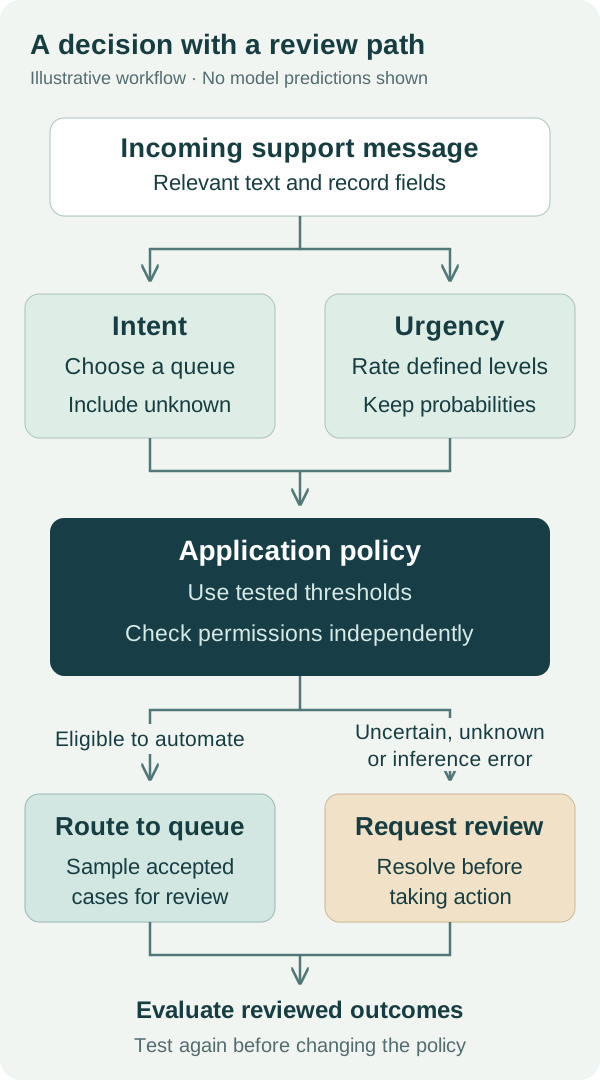
Figure 1. An illustrative decision-and-review workflow. Software checks permissions independently and controls escalation. Review outcomes inform later evaluation; they do not automatically retrain the model. Original schematic based on the interface and confidence guidance in references 3 and 15; no measured probabilities are shown.
Include ambiguous messages, missing information, negation and each language actually served. Laya documents failures on a small set of negated cancellation requests, including highly confident mistakes. Jev documents sensitivity to option order and literal wording. Changing labels alone is therefore insufficient evidence that a failure has been corrected. 14 13
Provide an explicit unknown or review route. Keep numerical comparisons and date arithmetic in code. Filter irrelevant document content, and inspect what survives truncation: Laya's option descriptions share a limited sequence budget with the state, while Jev documents degraded accuracy with distracting context. Large taxonomies may need a shortlist or hierarchical classification, evaluated end to end. 14 13
Pin model and package versions, then re-evaluate changes to prompts, precision or serving configuration. Keep API keys on the server. Define behavior for timeouts and unavailable inference, sample accepted decisions for review, and measure cold starts, tail latency and fallback traffic. Self-hosting removes a provider's per-request charge, but still consumes compute and operational effort.
The open problem is dependable selectivity
Jev and Laya make narrow language judgments easier to connect to software. Their most useful promise is that an application could automate an appropriate subset of decisions while retaining a clear review path.
The unresolved question is whether the system can reliably identify that subset as topics, languages and users change. Progress requires evidence about both the decisions it accepts and the errors it confidently overlooks. That is the standard against which a new checkpoint, a fine-tuning run or a routing policy should be judged.
References
- TypeSafe. Introduction. Official documentation, accessed October 3, 2026.
- TypeSafe. Models. Model IDs, customization and language guidance, accessed October 3, 2026.
- TypeSafe. Primitives. Choice, Score and Noul interfaces, accessed October 3, 2026.
- Convai Innovations. Laya model card. Architecture, checkpoints and training description, accessed October 3, 2026.
- Laya contributors. Release v0.3.24. GitHub, October 2, 2026 UTC.
- TypeSafe. AI primer. RLCD training objective, accessed October 3, 2026.
- Laya contributors. Benchmark report. Version 0.3.24, 2026.
- Laya contributors. T4 benchmark results. Committed aggregate evaluation artifact, 2026.
- TypeSafe. Intent routing. Application pattern, accessed October 3, 2026.
- Hugging Face and SetFit contributors. SetFit. Official repository, accessed October 3, 2026.
- Aurelio and contributors. Semantic Router. Official repository, accessed October 3, 2026.
- ggml-org and contributors. llama.cpp. Official repository, accessed October 3, 2026.
- TypeSafe. Jev 1.13 jaggedness. Limitations, reviewed October 2, 2026.
- Convai Innovations and Laya contributors. Laya README. Version 0.3.24; calibration and failure disclosures, 2026.
- TypeSafe. Confidence. Probability-derived certainty and routing guidance, accessed October 3, 2026.
- LocalLLaMA. Typed Decisions dataset card. Scenario construction, teacher labels and evaluation limitations, accessed October 3, 2026.