DHL, SAP and CargoWise show how technology is changing logistics
2026-10-17 · 9 min read
DHL announced plans to deploy more than 1,000 additional Boston Dynamics robots in May 2025. Their assignment was unloading boxes from trucks and containers, a warehouse job the company had begun automating commercially in North America in 2023 [1].
Shipping companies have another job for technology: replacing the paperwork that accompanies cargo. In June 2026, five electronic bill-of-lading providers adopted a common agreement for transferring documents between their platforms, according to the Digital Container Shipping Association's general counsel [2].
Both developments concern work that logistics operators have to get done every day. Robots handle cargo. Document platforms handle the agreements needed to move it. Between them sit the enterprise, warehouse and transport applications sold by companies including SAP, Manhattan Associates and CargoWise.
The examples below cover warehouse operations, freight planning, shipment tracking and trade documents. Sources were checked through 16 October 2026.
SAP and Manhattan handle different parts of an order
SAP's enterprise resource planning software, usually shortened to ERP, connects departments through a shared database. Inventory and logistics sit alongside finance and other business functions. Sales staff, warehouse teams and accountants can work with the same underlying information instead of maintaining separate versions of an order [3].
Manhattan Associates sells a warehouse management system, or WMS, that coordinates inventory, staff, order fulfillment and automated equipment. Its warehouse execution software manages automation within the WMS, and its order processing supports wholesale, retail and direct customer orders [4].
These products have different responsibilities. An ERP system holds the business transaction; a WMS organizes the work inside the warehouse. Connecting the two requires agreement about which system assigns a task and which reports that it has been completed. That division should be settled before implementation, since the customer-facing order depends on the warehouse update.
Stock corrections need a history. Keeping the reason for an adjustment and the person who entered it gives staff information to investigate a discrepancy. Overwriting the quantity alone loses that explanation.
The companies and technologies behind freight operations
Several categories of software can appear in the same operation. The table lists their documented functions and the records they manage; it does not rank the suppliers.
| System or technology | International example | Documented operational function | Record or coordination involved |
|---|---|---|---|
| ERP | SAP | Integrates business functions, including inventory, logistics and finance [3] | Shared commercial and stock records |
| WMS and warehouse execution | Manhattan Associates | Coordinates inventory, fulfillment, labor and automated equipment [4] | Warehouse tasks and execution state |
| Transportation management system | Manhattan Associates | Supports transport planning, carrier selection, dock appointments and freight invoice auditing [5] | Planned loads, dispatch instructions and charges |
| Freight forwarding software | CargoWise | Connects bookings, rates, shipping documents and invoicing across transport modes [6] | Forwarding job and its associated documents |
| Ocean shipment visibility | project44 | Combines carrier integrations, vessel tracking and port events [7] | Shipment identifiers and transport milestones |
| Shared visibility events | GS1 EPCIS | Standardizes event exchange across organizations, including sensor information [8] | Identified objects, event times, locations and business context |
| Warehouse robotics | DHL and Boston Dynamics | Automates unloading boxes from trailers and containers [1] | Physical unloading and connection to downstream equipment |
| Electronic bill of lading | DCSA | Defines standard document data and processes for container shipping [9] | Shipping document creation, exchange and transfer |
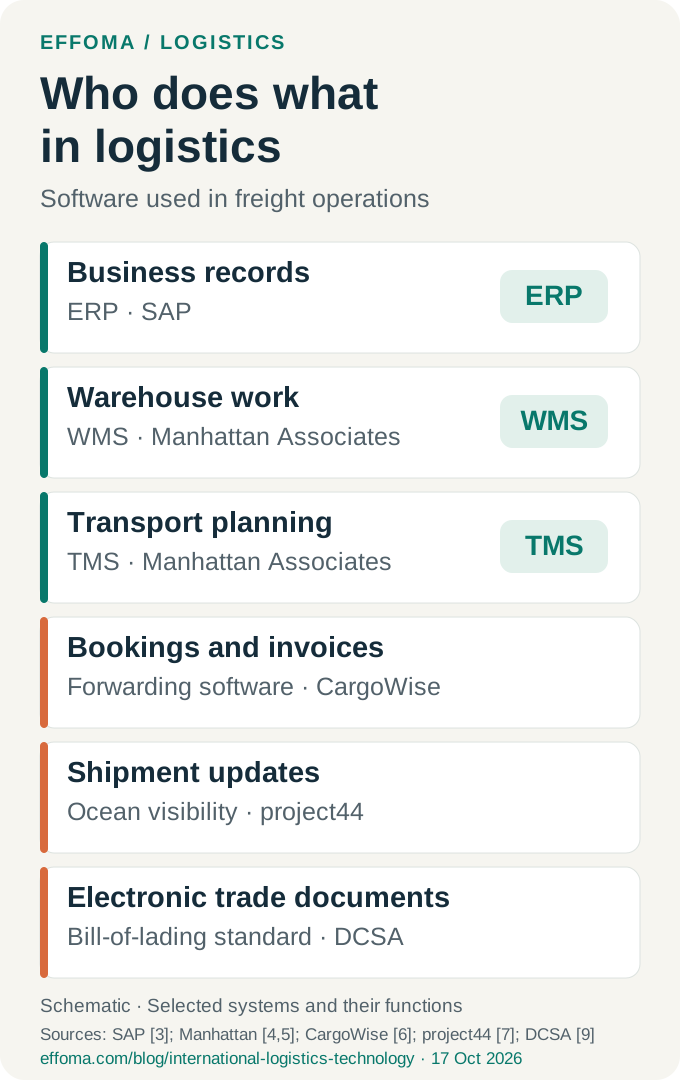
Figure 1. Software functions and international examples. Graphic by EFFOMA; sources in the table.
CargoWise connects bookings with freight documents
Manhattan also sells a transportation management system, or TMS. It covers shipment planning, carrier selection, dispatch, dock appointments and checks on freight invoices. Operators can use it to plan a load, issue instructions and compare a carrier's charges with the agreed rates [5].
Dock scheduling deals with a physical constraint: the receiving operation needs time to load or unload the truck. An arrival must fit into that schedule. Invoice auditing comes later, when the operator checks whether the billed services match the agreement. Both are documented functions of Manhattan's transport product [5].
CargoWise's forwarding software brings together quotations, bookings, carrier connections, shipping documents and invoicing. It supports air and ocean bookings, inland container movements, sailing schedules and the rates a forwarder buys and sells. The booking record can supply information for bills of lading, air waybills, invoices and packing lists [6].
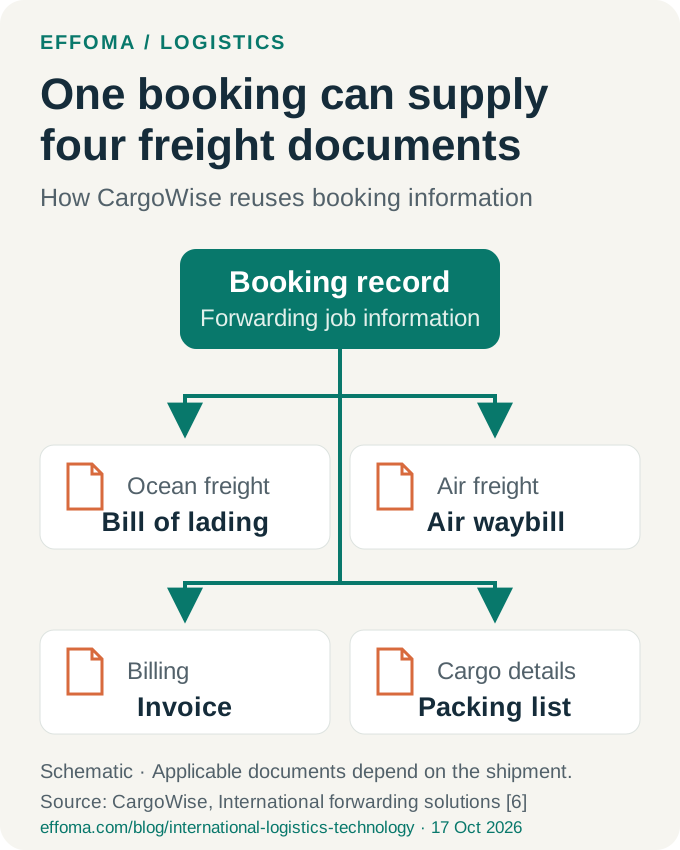
Figure 2. EFFOMA schematic based on CargoWise [6]. Arrows show information reuse. Documents vary by shipment.
Open the full-size document diagram
An error in a booking can spread to the documents generated from it. Correcting the original entry and identifying the affected documents belong in the same process, so staff can track which versions need updating.
project44 tracks ocean shipments across carriers
project44 gathers ocean shipment information from carriers, port events and vessel tracking through the Automatic Identification System, or AIS. Container numbers, booking references and bill-of-lading references identify shipments. The service matches containers to vessels and follows vessel changes when cargo is transferred during its journey [7].
Its developer documentation offers several ways to exchange updates. An application programming interface, or API, lets another system request information. Webhooks send updates when events occur; polling checks periodically for changes. Electronic data interchange, or EDI, exchanges structured business messages [7].
The shipment identifier, source and receipt time of an update help staff investigate a delayed message or compare two reports about the same movement.
GS1 tackles event exchange through Electronic Product Code Information Services, known as EPCIS. The standard connects identified objects with event times, locations and business context, allowing organizations to exchange records in an agreed format. Version 2.0 includes sensor information [8].
EPCIS separates the time goods were received from the time a sensor made an observation. A temperature reading may cover a period before delivery, so assigning it the delivery timestamp could misrepresent what happened. The standard includes fields for observation times and the device that supplied the data [8].
DHL's robot deal covers unloading boxes
Boston Dynamics' Stretch robot unloads boxes from trailers and containers. DHL's May 2025 announcement covered a memorandum of understanding for more than 1,000 additional units across its businesses. DHL reported that commercial use had started in North America in 2023 and expanded into the United Kingdom and Europe [1].
The agreement concerned planned deployment, so the figure should not be read as a completed installation count. DHL also described robots working with conveyors and palletizers in the United Kingdom. That surrounding equipment carries boxes into subsequent warehouse operations [1].
Five document providers agreed on transfers in June 2026
The Digital Container Shipping Association, or DCSA, publishes standards for bills of lading and sea waybills. Its work includes document data, APIs, business processes and transfers between electronic platforms. The association describes paper originals being couriered to importers for presentation when goods are collected [9].
DCSA General Counsel Omer Guy says CargoX, edoxOnline, TradeGo, WaveBL and eTEU adopted version 2 of its interoperability annex in June 2026. The annex was approved by the International Group of P&I Clubs. Guy describes three components: a technical standard, a registry recording which platform controls a document, and a shared legal agreement [2].
Tracking control is central to transferring an electronic bill between providers. The registry is intended to preserve that control across platforms [2]. DCSA's members have also committed to 100% electronic bills of lading by 2030, an adoption target that remains ahead of the industry [10].
An earlier effort ended without the participation its sponsors needed. In November 2022, Maersk and IBM announced they would discontinue TradeLens, the blockchain-enabled trade platform launched in 2018. Maersk said it had failed to secure the necessary global industry collaboration and commercial viability [11].
Maersk described a functioning platform that had failed to attract enough industry participation to sustain the business. The commercial outcome depended on carriers and other organizations adopting it [11].
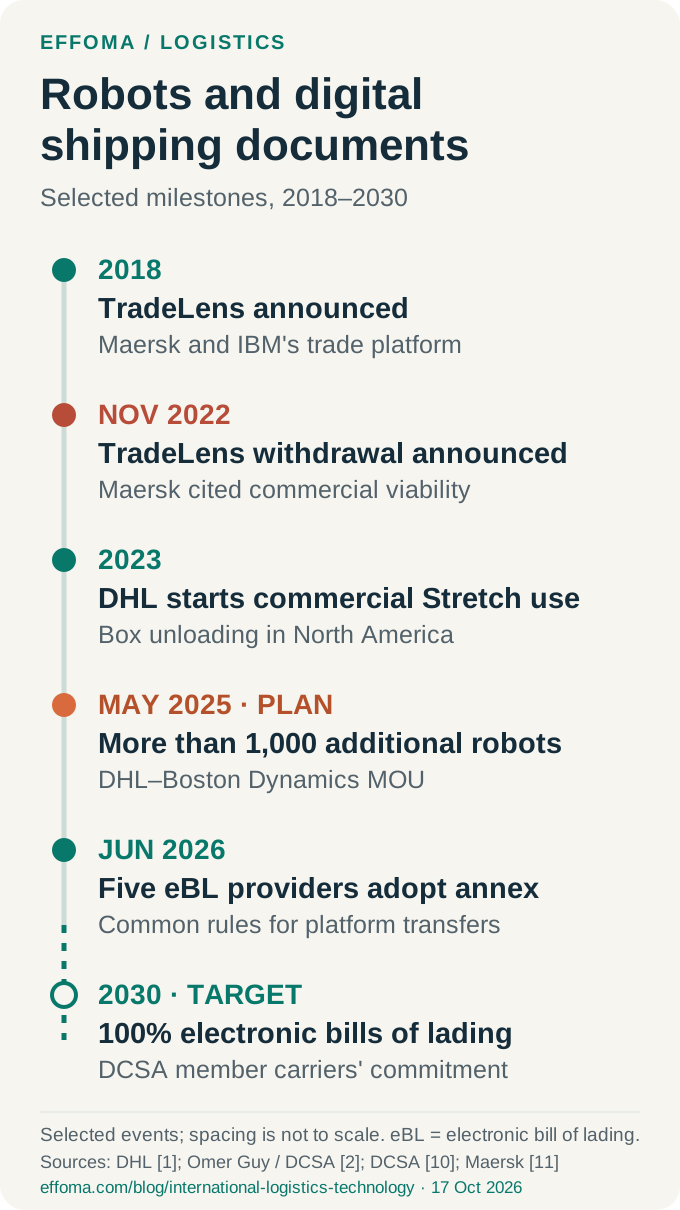
Figure 3. EFFOMA graphic; sources cited above. Spacing is not to scale. Robot expansion is planned; 100% electronic bills of lading is a target.
The June 2026 agreement gives participating document providers common rules for transfers. Wider use of those arrangements by carriers, forwarders and their customers remains the adoption problem behind the industry's 2030 commitment [2], [10].
References
[1] DHL Group, “DHL Group signs MOU with Boston Dynamics for additional 1,000-robot deployment and accelerates cross-business automation strategy,” May 13, 2025. Accessed: Oct. 16, 2026. [Online]. Available: https://group.dhl.com/en/media-relations/press-releases/2025/dhl-group-signs-mou-with-boston-dynamics-and-accelerates-cross-business-automation-strategy.html
[2] O. Guy, “The electronic bill of lading and the architecture of trust,” Digital Container Shipping Association. Accessed: Oct. 16, 2026. [Online]. Available: https://dcsa.org/newsroom/bel-interoperability-with-omer-guy
[3] SAP, “What is ERP? The essential guide.” Accessed: Oct. 16, 2026. [Online]. Available: https://www.sap.com/uk/resources/what-is-erp
[4] Manhattan Associates, “Warehouse management systems & WMS solutions.” Accessed: Oct. 16, 2026. [Online]. Available: https://www.manh.com/solutions/supply-chain-management-software/warehouse-management
[5] Manhattan Associates, “Transportation management system (TMS).” Accessed: Oct. 16, 2026. [Online]. Available: https://www.manh.com/solutions/supply-chain-management-software/transportation-management
[6] CargoWise, “International forwarding solutions.” Accessed: Oct. 16, 2026. [Online]. Available: https://www.cargowise.com/solutions/cargowise-forwarding/
[7] project44, “Ocean shipment visibility,” project44 Developer Portal. Accessed: Oct. 16, 2026. [Online]. Available: https://developers.project44.com/guides/shippers/visibility/ocean/p2p/overview
[8] GS1, “EPCIS standard,” release 2.0, Jun. 2022. Accessed: Oct. 16, 2026. [Online]. Available: https://ref.gs1.org/standards/epcis/2.0.1/
[9] Digital Container Shipping Association, “Electronic bill of lading standard.” Accessed: Oct. 16, 2026. [Online]. Available: https://dcsa.org/standards/bill-of-lading
[10] Digital Container Shipping Association, “We're committed to 100% usage of electronic bill of ladings by 2030.” Accessed: Oct. 16, 2026. [Online]. Available: https://dcsa.org/get-involved/100-percent-ebl
[11] A.P. Moller–Maersk, “A.P. Moller - Maersk and IBM to discontinue TradeLens, a blockchain-enabled global trade platform,” Nov. 29, 2022. Accessed: Oct. 16, 2026. [Online]. Available: https://www.maersk.com/news/articles/2022/11/29/maersk-and-ibm-to-discontinue-tradelens